Reducing No-Shows Without Damaging the Therapeutic Alliance
Listen to this post
Listen to this post
Reminder workflows, cancellation policies, and the quiet psychology that makes them work — or backfire.
Key takeaways
• No-show rates in mental health run high — often cited in the range of 29–50%, with first appointments the most fragile.
• Most missed sessions aren’t disrespect. They’re ambivalence, avoidance, forgetting, or the shame that follows a miss — which is clinical information, not a personal slight.
• Reminders work best when they’re frequent enough to help and neutral enough to never shame. Research consistently links them to fewer no-shows.
• A good cancellation policy is a boundary, not a punishment. Clear, signed up front, consistently applied, and humane about real emergencies.
There’s a particular quiet that settles in when a client doesn’t show. The chair stays empty, the hour you’d held disappears, and you’re left with a small knot of feelings — concern for the client, frustration about the lost time, maybe a flicker of self-doubt.
Then comes the dilemma. You could tighten things up — fees, firm policies, more reminders. But you also know the relationship is the work. Lean too hard on enforcement and you risk bruising the very alliance that brings people back. So how do you protect your schedule without turning into a collections agency?
The good news: the tools that actually reduce no-shows are the same ones that strengthen the relationship — when you understand the psychology underneath them.
First, why people miss
It’s tempting to read a no-show as a client not valuing your time. Occasionally that’s true. Far more often, the reason is clinical or simply human:
• Ambivalence and avoidance. For someone with anxiety, depression, or trauma, the appointment itself can be the hard part. Avoidance isn’t laziness; it’s often a symptom of the thing they came to work on.
• Forgetting and life friction. Busy weeks, executive-function challenges, a calendar that didn’t sync. Small obstacles, big effect.
• The shame spiral. This one’s underrated. A client misses once, feels embarrassed, and then avoids rebooking because they’re embarrassed — so one miss quietly becomes three.
Reframing no-shows this way changes everything. You’re not policing disrespect; you’re reducing friction and making it easy to come back. That mindset is what keeps your systems warm instead of punitive.
Reminders that help without nagging
Appointment reminders are the highest-leverage, lowest-risk move you can make. The evidence is consistent: practices that send reminders see meaningfully fewer no-shows, and adding reminders helps clients with a history of missing the most. One clinical trial found an extra text reminder cut the chance of a no-show by roughly 11%; some practices report missed-appointment rates dropping by more than half over time.
The trick is tone and timing.
• Keep the wording neutral and warm. “Hi [name], this is a reminder of your appointment with [clinician] on Tuesday at 2:00. Reply C to confirm or call to reschedule.” No guilt, no “please don’t miss again.” Matter-of-fact protects the relationship.
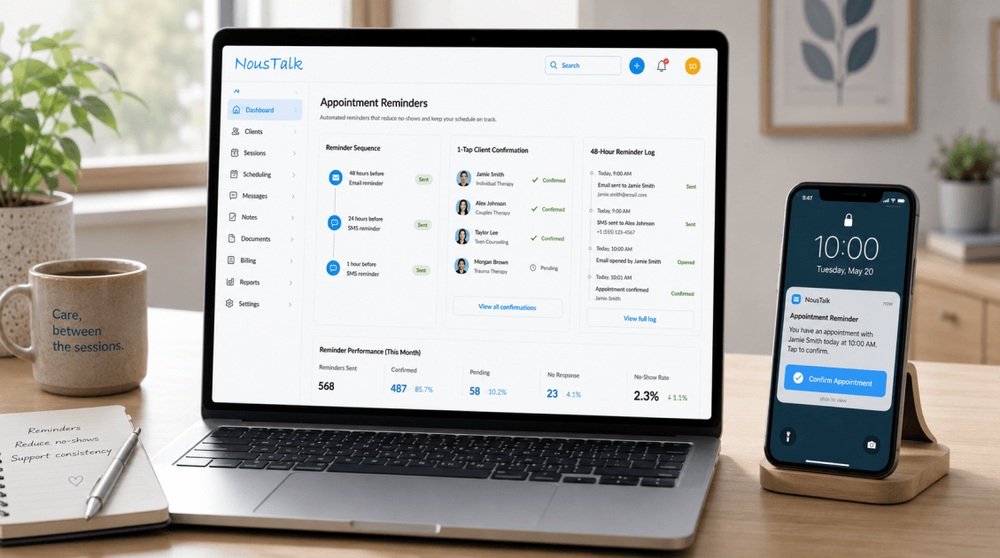
• Use more than one touchpoint. A confirmation at booking, then a reminder 48 hours out (enough time to rearrange life) and one the morning of, tends to outperform a single ping.
• Make the next action effortless. A one-tap confirm and an easy path to reschedule turn a reminder into a tiny re-commitment, not a chore.
• Mind the channel. Many clients live in text; some prefer email; a few still want a call. Honour consent and preference — and keep it HIPAA-appropriate.
A reminder isn’t just a memory aid. It’s a small, repeated signal that the client is expected, welcome, and easy to reach. That’s alliance-building disguised as logistics.
Cancellation policies that hold a line without punishing
A cancellation policy gets a bad reputation because people imagine it as a fee. It’s better understood as a clear agreement that protects both of you — your time and their continuity of care.
What makes one work:
• Clarity. Plain language, a reasonable notice window (24–48 hours is common), and consequences spelled out simply. No fine print.
• Signed up front. Reviewing and signing the policy during onboarding does real psychological work — it turns a vague understanding into a stated commitment, which people are far more likely to honour.
• Consistency. Applied evenly to everyone, so it never feels personal or arbitrary.
• Built-in humanity. A standing allowance for genuine emergencies. Rigidity is what ruptures alliances; reasonable flexibility is what preserves them.
A note on fees: they can reduce casual cancellations by giving the appointment some weight, but they’re the part most likely to strain the relationship. If you charge one, frame it as a neutral, known consequence — never a penalty delivered with disappointment — and consider waiving it the first time or in clear hardship. The goal is commitment, not retribution.
The psychology, in one idea
Most of what works here runs on a single principle: lower the friction to showing up, and raise the (gentle) friction to drifting away.
Reminders, easy rescheduling, and a warm front door lower the cost of attending. A signed policy and a confirm-or-reschedule prompt add just enough weight that skipping isn’t frictionless. You’re not coercing anyone — you’re nudging, and leaving the autonomy with the client where it belongs.
And when a session is missed anyway, the most powerful move is the least punitive one: a brief, non-shaming reconnect. “Sorry we missed you Tuesday — want to grab a time that works better?” That single message can interrupt the shame spiral before it costs you the client entirely.
A simple setup to start with
If you’re building this from scratch, a workable baseline looks like:
1. A clear, plain-language cancellation policy reviewed and signed at intake.
2. An automated reminder sequence: confirmation at booking, plus 48-hour and same-day reminders.
3. A frictionless way to confirm or reschedule in one tap.
4. A warm, standard re-engagement message for anyone who misses.
5. A quarterly look at your no-show numbers to see what’s actually working.
Start there, watch what happens, and adjust. Small, consistent systems beat heroic effort.
Where your tools can help
This is largely a workflow problem, which means good software can carry most of the weight. Automated reminders across text and email, online booking that lets clients reschedule themselves, your cancellation policy built into digital intake, and a simple no-show report all turn good intentions into something that runs on its own. In NousTalk, those pieces live together, so the gentle, consistent follow-through happens without you having to remember it mid-session — leaving your attention where it should be, on the client in the room.
The bottom line
You don’t have to choose between a full schedule and a strong alliance. Reminders, a clear policy, and an easy path back are not the opposite of good care — done warmly, they are good care. They tell clients, again and again, that their time is held and their return is welcome.
If no-shows have been wearing on you, pick one change this week — the reminder sequence is the easiest place to start — and let the system do the gentle remembering for you.
This article is for general educational purposes and isn’t legal, clinical, or financial advice. Reminder consent rules, fee practices, and documentation requirements vary by jurisdiction, payer, and the college or association you’re registered with — always follow your own regulator’s standards.
Smart Appointment Scheduling
Automate SMS & email reminders to reduce client no-shows by over 50%.
Explore Feature Page