Practising Across Lines
A Logistics Guide to Multi-State and Multi-Province Licensure
PSYPACT and the compacts are opening doors to underserved regions. Here’s how to walk through them without tripping over the paperwork.
Key takeaways
• One rule governs everything: you generally must be authorized to practise where your client is physically located at the time of the session — not where you are.
• In the U.S., interstate compacts (PSYPACT, the Counseling Compact, the Social Work Compact) are making cross-state telehealth far more workable, though each is at a different stage.
• In Canada, there’s no PSYPACT-style compact; cross-province practice runs through each province’s regulatory college, with labour-mobility rules easing the path.
• The licence is only half the job. Malpractice coverage, client-location tracking, consent, and safety planning all need to travel with you across borders.
There’s a quiet frustration many clinicians know well: a client moves two hours away to a town with a months-long waitlist and no one who does your kind of work — and you, the person who already knows their story, may not be allowed to keep seeing them. Multiply that by every rural and underserved region, and you can see why so many therapists are looking seriously at practising across state and provincial lines.
The demand is real, and the access need is genuine. The catch is that the map of who you can legally see isn’t drawn by geography or need — it’s drawn by licensure. The good news is that the routes across those lines are clearer than they’ve ever been. Here’s a practical guide to the logistics.
The one rule everything hangs on
Before any compact or credential, internalize this: you must be authorized to practise where the client is located when the session happens. A client sitting in another state or province is, for licensing purposes, being seen there — not in your office.
That single principle is the source of nearly every cross-border requirement that follows. It’s also why “I’m licensed, so I can see anyone online” is one of the more dangerous assumptions in telehealth. Where your client physically is, at the moment you meet, is what counts.
The U.S. picture: compacts are maturing
Interstate compacts are agreements among states that let a clinician licensed in one member state practise in others without collecting a stack of individual licences. For behavioural health, three matter most:
• PSYPACT (psychologists). The most established. Run by the ASPPB, it now spans roughly 43 states and territories. Psychologists obtain an E.Passport and Authority to Practise Interjurisdictional Telepsychology (APIT) for telehealth across member states, or an Interjurisdictional Practice Certificate (IPC) for temporary in-person work (commonly up to 30 days per year per state).
• The Counseling Compact (LPCs / LMHCs). Newer and rolling out fast. It became active in its first states in late 2025, with a large group of additional states enacted and working toward issuing privileges.
• The Social Work Licensure Compact. Enacted in a growing number of states and activated, but still in build-out — multi-state licences aren’t being issued yet, and implementation is expected to take a while longer.
One gap worth naming: marriage and family therapists don’t yet have a national compact, so MFTs generally still need individual state licensure to practise across lines. A handful of states also offer telehealth-only registration pathways as an alternative route.
Because these are moving targets — states join, statuses change, rules get refined — treat any specific count as a snapshot and confirm current status with the official compact body before you rely on it.
The Canadian picture: colleges and labour mobility
If you’re practising in Canada, the framework is different. There is no PSYPACT-style compact across the provinces. Psychology, counselling/psychotherapy, and social work are each regulated province by province, and the general expectation is that you’re registered with the regulatory college in the province where your client is located.
What helps is labour mobility. Under Canada’s internal-trade arrangements, a professional in good standing in one province is generally entitled to registration in another without redoing their whole credentialing — but it’s still a registration process with each college, not an automatic, single-credential reach. If you’re planning to see clients in another province, start with that province’s college early; timelines and requirements vary.
Beyond the licence: the logistics that travel with you
Getting authorized in a new jurisdiction is the headline, but it’s only part of the work. These pieces need to cross the border with you:
• Malpractice coverage. A claim is typically governed by the law where the client is located, not where you’re licensed or sitting. Confirm in writing that your policy covers telehealth in every jurisdiction you’ll serve — many policies have telehealth or multi-state provisions worth checking before you start.
• Knowing and documenting client location. Since location drives everything, verify where the client is at the start of each session and note it. A client who’s travelling can quietly put you in a jurisdiction you’re not authorized for.
• Consent that matches the jurisdiction. Telehealth consent requirements differ by location. The consent you use for a local client may not satisfy the rules where a distant client sits.
• Safety planning per location. Know the client’s address that day and a local emergency contact and local crisis resources, so a hard moment isn’t compounded by being a province or state away.
• Business and tax registration. Practising in another jurisdiction can carry business-registration or tax implications beyond your licence. This is genuinely an “it depends” area — worth a quick conversation with an accountant or attorney familiar with the jurisdictions you’re adding.
• Records and continuity. Keep documentation consistent across jurisdictions so a client’s record reads as one coherent story regardless of where each session happened.
A measured way to expand
You don’t have to take this on all at once. A workable sequence:
1. Start with the need. Identify the specific region or clients you want to reach, rather than collecting credentials speculatively.
2. Confirm your route. Check whether a compact covers your profession and that jurisdiction, or whether you need direct licensure or registration.
3. Apply early. Build in time — compact credentials and college registrations both take longer than you’d hope.
4. Square away coverage. Get written confirmation that malpractice and any payer requirements extend to the new jurisdiction.
5. Update your workflows. Add location verification, jurisdiction-appropriate consent, and local safety resources before the first session — not after.
6. Revisit periodically. Compacts and rules evolve; recheck the status of the jurisdictions you serve at least once a year.
Where your tools can help
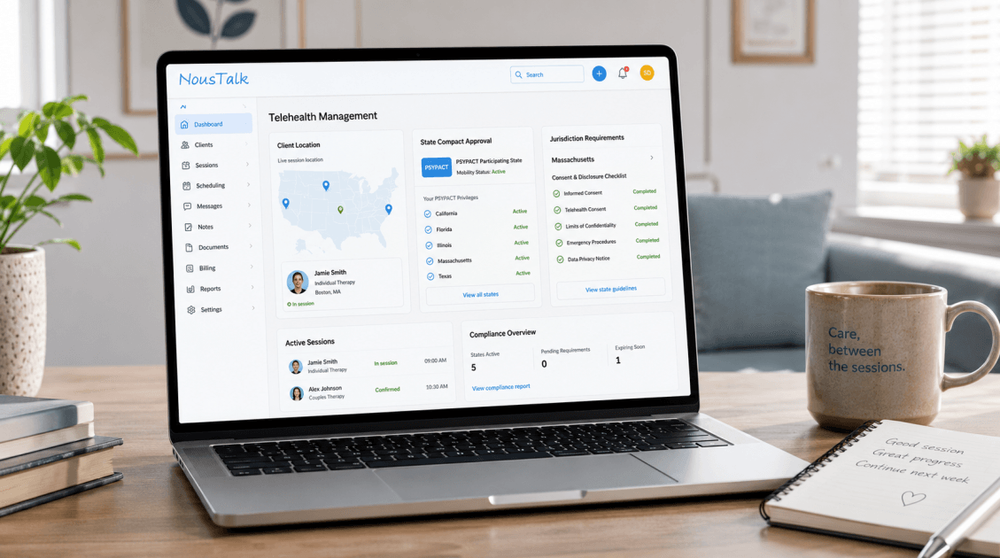
Multi-jurisdiction practice is, at its core, a tracking problem — and that’s where good systems earn their keep. Recording each client’s location, attaching the right consent for that jurisdiction, capturing where and how each session happened, and keeping one clean record across borders are all things software should handle so you don’t have to hold them in your head. In NousTalk, client records, consent, scheduling, and notes live in one place, so the details that change with geography stay attached to the right client and session rather than scattered across tools.
The bottom line
The compacts and labour-mobility rules exist for a good reason: there are people in underserved regions who need care that geography has been keeping from them, and you may be exactly the clinician to provide it. Practising across lines is very doable — it just rewards doing the logistics deliberately. Anchor everything to where your client is located, get the licence and the coverage right, and let your workflows carry the rest.
If expanding your reach has been on your mind, start with one jurisdiction and one question: what does it take to be properly authorized where my client will be? Answer that well, and the door is open.
Further reading
• PSYPACT States: A State-by-State Guide — Psychology.org
• Telehealth Licensure 2025–2026: Cross-State Practice and Compacts — Telehealth.org
• Licensing Across State Lines — Telehealth.HHS.gov
This article is for general educational purposes and isn’t legal, clinical, tax, or financial advice. Licensure, compact participation, malpractice, consent, and tax rules vary by jurisdiction and change frequently — always confirm current requirements with the relevant licensing body, your insurer, and a qualified professional before practising across state or provincial lines.
Multi-Jurisdiction Telehealth
Expand your practice securely across state and provincial boundaries.
Explore Feature Page