Hybrid by Default
Why Clients Now Expect Both Virtual and In-Person Options
The expectation has quietly shifted — and your scheduling and consent workflows are where you meet it.
Key takeaways
• Offering both virtual and in-person sessions is no longer a perk; for many clients it’s the baseline expectation.
• Choice itself matters: when clients aren’t offered a say in how they meet, satisfaction and rapport tend to suffer.
• Hybrid works best as one practice with two doors — not two parallel systems. Treat modality as a property of each appointment.
• The compliance weight sits in two places: telehealth consent (which generally follows where the client is located) and clear documentation of the modality used.
A few years ago, “Do you offer virtual sessions?” was an unusual question. Now it’s often the first one a prospective client asks — sometimes before they ask about your approach or your fees.
What changed isn’t just technology. It’s expectation. Clients have learned that therapy can fit around a commute, a sick kid, a business trip, or a week when leaving the house feels impossible — and they’ve also learned there are moments when sitting in the same room matters. So they want both. Not virtual or in-person, but the flexibility to choose, sometimes week to week.
For a solo clinician or a group clinic, that shift raises a practical question: how do you offer genuine flexibility without doubling your workload or tangling your paperwork? The answer lives almost entirely in two workflows — scheduling and consent.
Why “hybrid by default” became the expectation
The numbers tell a consistent story. In one study, 83% of virtual behavioural health clients said they’d prefer a hybrid program over either format alone. An APA survey found roughly 77% of psychologists now offer telehealth. And research in 2025 points to hybrid models improving both client retention and clinician satisfaction, with some studies finding that blending virtual sessions with targeted in-person work improves adherence.
Here’s the finding worth sitting with, though: when clients aren’t offered a choice of modality, satisfaction drops and the therapeutic rapport can weaken. In other words, flexibility isn’t only a convenience — the act of giving someone a say is itself relational. It signals that their circumstances and preferences are part of the plan.
That’s the real case for going hybrid by default. It’s not chasing a trend; it’s meeting people where they are, which is something clinicians have always tried to do.
One practice, two doors: structuring scheduling
The most common mistake is treating virtual and in-person like two separate practices — separate calendars, separate habits, separate confusion. The cleaner mental model is one practice where modality is just a property of each appointment, chosen at booking and easy to change.
A few principles make that work in practice:
• Make modality explicit at booking. Every appointment should carry a clear label — virtual or in-person — that both you and the client can see. Ambiguity here is what produces the dreaded “I thought we were on video today.”
• Let clients choose, within your boundaries. Offer the choice where it’s clinically appropriate, while reserving your judgment for situations that genuinely call for one format (for example, certain assessments or higher-acuity work).
• Build in the logistics each format needs. In-person sessions need a room and travel time; virtual sessions need a secure link, a tech buffer, and a quiet space on your end. Bake those into how the slot is built, not into your memory.
• Send modality-specific reminders. A reminder that includes the video link for virtual sessions, or the address and parking note for in-person, removes friction at exactly the moment it tends to appear.
• For group clinics, keep it visible to the team. Front-desk staff and covering clinicians should be able to see at a glance how each session is happening, so no one walks a client to a room that’s actually a Zoom call.
Done well, the client experiences seamless flexibility, and you experience one coherent schedule instead of two.
The part that needs care: consent workflows
Hybrid care adds a real compliance dimension, and it’s worth getting right rather than guessing. The good news: it’s manageable once you know where the weight sits.
• Telehealth needs its own informed consent. Beyond your standard consent, virtual care generally requires clients to understand what telehealth involves, its benefits and limits, privacy considerations (especially if they’re somewhere non-clinical), what happens if the connection drops, and that in-person care remains an option.
• Location of the client usually governs the rules. Telehealth requirements typically follow where the client is physically located at the time of the session — not where you are. That affects both consent specifics and whether you’re licensed to practise there. Confirm your licensure or compact eligibility for the client’s location, and reflect it appropriately.
• Refresh consent when the modality changes. Many jurisdictions expect consent to be revisited when care shifts formats, at a defined interval, or when your policies or the material risks change. A client who started in person and is now meeting virtually may need to consent to that shift.
• Document the modality every session. Note how each session happened — virtual or in-person — along with the client’s location for virtual visits where relevant. It’s a small habit that keeps your records clean and defensible.
• Plan for safety across formats. For virtual sessions, know the client’s physical address that day and a local emergency contact, so a crisis isn’t compounded by not knowing where they are.
None of this is a reason to avoid hybrid care. It’s simply the homework that makes it safe — and most of it can be handled once, up front, in your intake and then maintained with light touches.
Because these rules vary by jurisdiction, payer, and your specific regulator, treat the above as a map of what to check, not a substitute for your own college’s or board’s current standards.
A simple setup to start with
1. Add a clear modality field (virtual / in-person) to every appointment type you offer.
2. Build a telehealth-specific consent into your onboarding, alongside your standard consent.
3. Confirm licensure and consent rules for the locations your clients actually connect from.
4. Set modality-specific reminders — links for virtual, address and arrival notes for in-person.
5. Make “document the modality” part of your note-writing habit.
6. Revisit consent when a client switches formats or at your set interval.
Where your tools can help
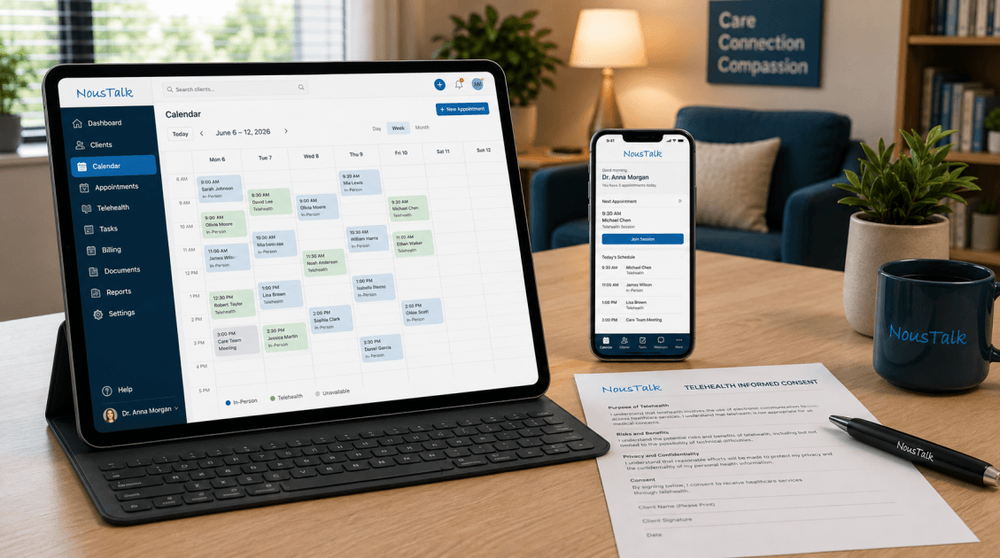
Hybrid care is mostly a coordination problem, and that’s exactly what good software is for. Scheduling that treats modality as a built-in option, secure video tied to the virtual appointments, telehealth consent folded into digital intake, and a record that captures how each session happened — together these turn “offering both” from a juggling act into a default that runs quietly in the background. In NousTalk, scheduling, telehealth, intake, and notes share the same system, so the modality a client chooses flows through booking, reminders, the session itself, and the chart without you re-entering it anywhere.
The bottom line
Hybrid by default isn’t about being everything to everyone. It’s about giving clients a say in how they show up for their own care — and building the quiet infrastructure that lets you honour that choice without extra strain. Get the scheduling clear and the consent solid, and the flexibility stops being a burden and starts being a feature clients feel from the first appointment.
If you already offer both formats informally, the next step is small: tighten the two workflows behind them, starting with consent. The flexibility is already what your clients expect — this just makes it dependable.
Further reading
• Hybrid Mental Health Care: 2025 Research Insights — Telehealth.org
• Obtaining Informed Consent for Telebehavioral Health — Telehealth.HHS.gov
• Telemental Health, Hybrid, and In-Person Outpatient Mental Health Care in the US — JAMA Psychiatry
• Telehealth Consent Requirements: What Providers Must Include — Accountable
This article is for general educational purposes and isn’t legal or clinical advice. Telehealth consent, licensure, and documentation requirements vary by jurisdiction, payer, and the college or association you’re registered with — always follow your own regulator’s standards, based on where your client is located.
Telehealth & Hybrid Practice Solutions
Seamlessly combine in-person sessions with secure virtual video care.
Explore Feature Page