How to Tell Clients You Use AI for Notes
With a Free Consent Template
Why disclosure matters, what to say, how to say it well — plus a customizable sample consent you can adapt for your practice.
Key takeaways
• If an AI tool touches a client’s information — recording a session, transcribing it, or drafting notes — clients have a right to know, and disclosure is increasingly an explicit expectation in professional ethics guidance.
• The conversation matters as much as the form: plain language, a clear “why,” and a real option to decline tend to build trust rather than erode it.
• You stay responsible for the record. AI drafts; you review, edit, and sign. Say so out loud.
• We’ve included a free, editable consent template (Word and PDF) you can tailor to your tool, your practice, and your jurisdiction.
You’ve started using an AI tool to help with your notes — maybe it transcribes the session, maybe it drafts a progress note you then edit. It’s saving you real time, and your documentation is more consistent. Then a quiet question surfaces: Do my clients know about this, and how do I tell them without making it weird?
It’s a fair thing to sit with. The therapeutic relationship runs on trust, and clients are understandably sensitive about who — or what — has access to what they share. The good news is that handled well, this conversation is straightforward and can even strengthen trust. Here’s why disclosure matters, what to cover, how to say it, and a consent template you can make your own.
How do I disclose the use of AI — and why is it important?
Disclosure can be as simple as a short conversation paired with a written consent the client signs — ideally at intake, or before you first use the tool with them. You explain in plain terms what the tool does, what it means for their information, and that they can say no. The written piece documents that the conversation happened and what was agreed.
Why it matters comes down to a few things:
• It’s an ethics expectation. Recent guidance from professional bodies points the same direction. The American Psychological Association’s 2025 ethical guidance for AI in health-service psychology frames informed consent and transparency as core obligations — telling clients when and how AI is used, in plain and culturally appropriate language, and offering alternatives. The American Counseling Association’s recommendations for counselors echo this, stressing transparency and that the licensed professional remains responsible for decisions and outcomes.
• It’s part of informed consent. Clients agree to how their care and their information are handled. An AI tool that records sessions or processes what they tell you is a meaningful part of that picture, not a back-office detail.
• It’s a privacy issue. If the tool handles protected health information, you likely need a vendor agreement that meets your privacy obligations (in the U.S., a Business Associate Agreement under HIPAA; in Canada, arrangements that satisfy PIPEDA or your provincial law). Disclosure to clients sits alongside — not instead of — getting those vendor protections right.
• It protects the relationship. Most people are far more comfortable with a tool they were told about than one they discover. Transparency now prevents a rupture later.
A useful rule of thumb: if a client would be surprised to learn how their information is being handled, that’s a sign it should have been disclosed.
What to include in the conversation
You don’t need a script, but a good disclosure covers a predictable set of points. Aim to touch each of these in language a non-clinician would understand:
• What the tool is and what it does. For example, “I use a tool that helps me draft my notes” or “records and transcribes our session so I can focus on you instead of writing.”
• What information it handles. Whether it captures audio, a transcript, or only the notes you type — and whether anything is recorded.
• Who provides it and how their information is protected. That the vendor is bound by an agreement to safeguard their data, that it’s stored securely, and how long recordings or transcripts are kept.
• That you remain in charge. The AI assists; you review, edit, and approve every note, and all clinical decisions are yours. This reassurance matters more than almost anything else.
• Whether their data trains the AI. Many clients want to know this. Be able to say plainly that it does not — unless they’ve separately agreed.
• Their choices. That using the tool is voluntary, they can decline or withdraw consent at any time, you’ll use standard note-taking instead, and their care won’t be affected either way.
• Where to bring questions. A name and a way to reach someone.
If you can’t yet answer one of these about your own tool — particularly the privacy and data-training points — that’s worth resolving before you disclose, not after.
How to talk to clients about AI use: best practices
The content is half of it; the delivery is the rest. A few principles keep the conversation natural and trust-building.
• Lead with the “why,” framed around them. “I want to be fully present with you rather than buried in note-taking” lands better than a technical description. Connect the tool to their care.
• Use plain, jargon-free language. Skip “LLM,” “ambient scribe,” and “natural language processing.” Say what it does in everyday words.
• Be matter-of-fact, not apologetic. Your calm, transparent tone signals this is a considered, ethical choice — not something to be sheepish about.
• Make the opt-out genuinely easy. Say clearly that declining is completely fine and won’t change anything about their care. An opt-out that feels real is what makes consent meaningful.
• Invite questions and check for understanding. “What questions do you have about that?” is better than “Does that make sense?” Leave room for concerns, especially from clients with privacy worries or trauma histories around surveillance.
• Match the moment. Bring it up at intake or before first use, when there’s space to talk — not rushed in the last two minutes of a session.
• Document the conversation. Note that you discussed it and what was decided, and keep the signed consent in the record.
• Revisit when things change. If you switch tools or change how data is handled, that’s a new conversation, not a one-and-done.
A short, confident, human explanation usually does more for trust than a long legal recitation. You’re modelling exactly the kind of openness the relationship runs on.
Sample consent for use of artificial intelligence (AI) tools in your therapy services
To make this easier, we’ve included a free, customizable consent template — available as an editable Word document and a print-ready PDF. It’s written in plain, client-facing language and organized around the points above:
• A short, plain-language description of how AI is used in the client’s care.
• How their information is protected, stored, and retained — with a placeholder for your vendor agreement.
• A clear statement that you review and approve everything and that data isn’t used to train AI without separate consent.
• A voluntary-choice section with consent / decline options.
• Signature lines for the client, a parent or guardian where relevant, and the clinician.
The template uses bracketed placeholders — [tool name], [vendor], [retention period], and so on — so you can drop in your specifics. Treat it as a starting point, not a finished legal document: adapt the wording to your services, and check it against your regulator’s requirements and the privacy laws where you practise before using it. It’s meant to save you a blank page, not to replace your own (or your lawyer’s) judgment.
Where your tools can help
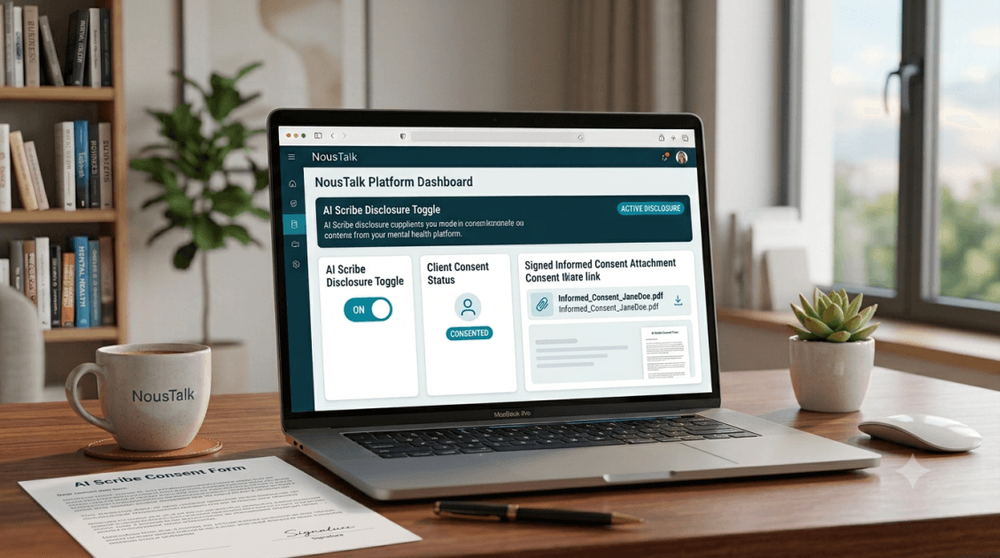
Once a client has consented, the practical question is keeping that consent — and the conversation around it — connected to the rest of the record. Storing the signed form with the client’s chart, and noting in your documentation that the discussion took place, means the consent is easy to find if a question ever comes up. In NousTalk, you can keep a signed consent alongside a client’s file and document the disclosure in your notes, so the paperwork and the care stay in one place rather than scattered across folders.
Conclusion
Telling clients you use AI for notes isn’t a hurdle to clear — it’s a small act of transparency that fits naturally into the trust you’re already building. Explain what the tool does, keep yourself clearly in charge of the record, make declining genuinely easy, and write down what was agreed. Do that, and most clients will appreciate the honesty.
Download the consent template below, adapt it to your tool and your jurisdiction, and you’ll have the conversation — and the documentation — ready to go.
Download the template
Included with this post:
• Sample AI Consent Template — a customizable client-facing consent for the use of AI tools in therapy services, in two formats: an editable Word document you can tailor, and a print-ready PDF in NousTalk style.
(Bracketed placeholders mark what to customize. It’s a template, not legal advice.)
Further reading / Sources
• Recommendations for Practicing Counselors and Their Use of AI — American Counseling Association
• Business Associates — U.S. Department of Health & Human Services (HIPAA)
• Business Associate Contracts (sample provisions) — U.S. Department of Health & Human Services
• Ethical Decision-Making Guidelines for Mental Health Clinicians in the AI Era — PMC
This article is for general educational purposes and isn’t legal, clinical, or compliance advice. The sample consent is a starting template, not a vetted legal document. Confirm your obligations with your regulator (your college, board, or association) and the privacy laws that apply where you practise, and consider legal review before adopting any consent form.
NousTalk AI Scribe & Clinical Privacy
Transparent, HIPAA-compliant AI note generation built for mental health therapists.
Explore Feature Page