Finding a Clinical Note Template That Actually Fits Your Practice
Listen to this post
Listen to this post
How the right template — general or purpose-built — can cut your documentation time without flattening your clinical voice.
Key takeaways
• A clinical note template is a structured outline that prompts you to record the right details in a consistent order. Used well, it speeds up documentation, improves note quality, and lowers the mental effort of writing.
• General formats like SOAP, DAP, and BIRP cover most routine sessions. Intakes, assessments, and specialized work (couples, ABA, psychological testing, third-party reports) usually call for purpose-built templates.
• Most clinicians end up with a small library — an intake, a progress note, a discharge summary, maybe a letter or report — rather than one template for everything.
• Don’t hunt for the “perfect” template. Pick one close to your needs, compare it against a note you’re proud of, and adapt from there.
It’s 7:15 on a Thursday. Your last client left an hour ago, and you’re still staring at a blinking cursor, trying to remember whether you documented the safety check-in from your 2 o’clock — and how you usually phrase it. Every note starts from scratch, and every note takes a little more out of you.
If that sounds familiar, you’re in good company. Research on documentation burden consistently finds that clinicians spend a substantial share of their working hours on notes and charting, and behavioural health notes carry a particular weight: they’re narrative, not numeric. You can’t reduce a session about grief to a checkbox. The American Psychological Association and others have repeatedly flagged administrative and documentation load as a leading contributor to practitioner burnout — the kind that shrinks caseloads and pushes good clinicians out of the field.
A clinical note template won’t fix all of that. But it’s one of the highest-leverage, lowest-cost changes you can make this week.
What a note template actually does for you
A clinical note template is a structured document that prompts you to record specific details in a predetermined order. Instead of deciding how to organize each note while also recalling the session, you follow a consistent scaffold and fill in the clinical substance. The benefits tend to show up in four places:
• Faster documentation. You stop rebuilding the structure of every note from memory. The outline is done; you supply the content.
• More complete, consistent notes. A good template covers the elements your notes need every time — presenting concerns, interventions used, client response, risk considerations, plan — so nothing important gets skipped on a tired Friday.
• Lower cognitive load. Many clinicians describe the relief plainly: you follow the template rather than compose from a blank page. After six sessions in a day, that difference is not small.
• More presence in session. When you trust that your documentation structure will catch what matters, you can spend less of the session mentally drafting the note and more of it with the person in front of you.
None of this replaces clinical judgment. The template holds the structure; you hold the thinking.
General formats vs. purpose-built templates
If your caseload is mostly routine individual sessions, a general format will likely serve you well. SOAP (Subjective, Objective, Assessment, Plan), DAP (Data, Assessment, Plan), BIRP (Behavior, Intervention, Response, Plan), and their cousins GIRP and PIRP are all proven structures for documenting a wide range of clinical encounters. DAP is a common choice in outpatient counselling and private practice; BIRP grew out of community mental health and substance-use settings and shines when you need to track interventions against observable change.
But as your practice grows more specialized, your template needs usually evolve. Consider two clinicians:
Priya is an associate therapist at a group practice. Most of her week is weekly individual CBT sessions with adults — established clients, familiar presentations, steady treatment plans. A single well-built DAP progress note template, plus the practice’s standard intake form, covers nearly everything she writes.
Marcus is a psychologist in solo practice with a more varied caseload. He conducts ADHD and psychoeducational assessments, sees couples, writes reports for schools and insurers, and coordinates care with psychiatrists and family physicians. One progress note format can’t stretch across all of that. Marcus needs several purpose-built templates: an assessment intake, a testing report shell, a couples session note, a treatment summary, and a collateral letter.
Neither approach is better — they’re matched to different practices. The question is simply which clinician your week looks more like.
Where to find templates
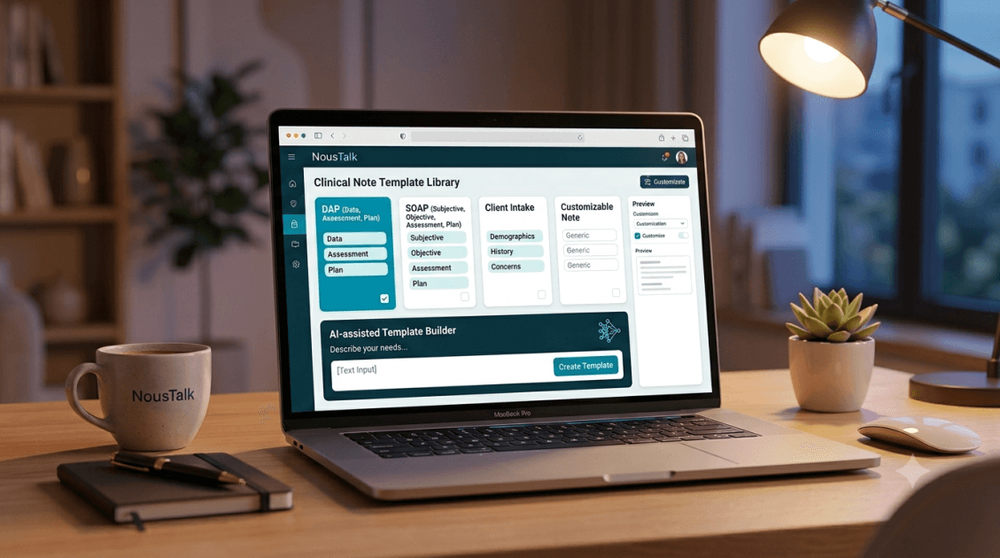
You can build your own from scratch, but it’s usually faster to start from one built for your setting and adapt it. Colleagues are a good first source — most are happy to share a de-identified note structure. Professional associations publish format guidance, and many EHRs designed for mental and behavioural health — NousTalk among them — include a library of intake, progress note, and discharge templates you can customize rather than create.
Wherever you find a template, treat it as a starting point. Your regulator (your college, board, or association) and your payers may have documentation expectations of their own, so check the template against those before you adopt it.
How to choose: four practical tips
1. Decide how many templates you need. Most practitioners maintain a small library rather than one universal template. A reasonable starting list: an intake/initial assessment, a progress note, a discharge or transfer summary, and — depending on your work — a treatment plan, a couples or family session note, or a report template for third parties.
2. Keep a reference note for comparison. Before you evaluate anything, pull up a note you’re proud of — one of yours or a colleague’s — and notice what makes it good. Then hold each candidate template against it and ask: would this structure produce something as clear and complete as my reference note? If a template would strip out what makes your best notes useful, keep looking.
3. Match the template to the encounter, not the other way around. SOAP, DAP, or BIRP will handle a routine follow-up comfortably. Initial assessments, risk evaluations, testing feedback sessions, and complex family work usually need something more comprehensive and purpose-built. Using a bare-bones progress note format for an intake means either an incomplete record or a lot of improvising — the two things templates exist to prevent.
4. Remember you can edit it. Don’t get stuck searching for the “just right” template. Whatever you choose, you’ll almost certainly tweak it — reorder sections, add a standing risk-assessment prompt, cut fields you never use. Pick the closest fit and refine it over your first few weeks of real use. And if adapting feels harder than describing, some platforms now offer an AI-assisted template builder: you describe the note you want in plain language, it drafts the structure, and you refine from there.
A simple example: DAP progress note template
Here’s a basic DAP structure you could adapt for routine individual sessions. (If you prefer SOAP, we’ve covered that format in detail in a separate post.)
Client: — Date/Time: — Session #: — Modality: (in person / telehealth)
Data: What the client reported and what you observed. Presenting concerns this session, mood and affect, relevant events since last session, mental status observations, any risk indicators and how they were assessed.
Assessment: Your clinical impression. Progress toward treatment goals, response to interventions used this session, changes in presentation, updated risk formulation if applicable.
Plan: What happens next. Interventions planned for upcoming sessions, homework or between-session tasks, referrals or coordination, next appointment.
That’s it — three sections, each answering a question you’re already asking yourself: What happened? What do I make of it? What’s next?
Where your tools can help
A template only saves time if it’s where you need it, when you need it. This is where a practice platform built for mental and behavioural health earns its keep. In NousTalk, you can start from the built-in template library (intake, progress note, discharge, and specialty formats), or describe the note you want and let the AI-assisted template builder draft the structure for you to refine. Once your templates are set, the right one is ready inside each client’s chart, with AI-assisted drafting available to give you a head start you then review, edit, and sign. The structure and the first draft get faster; the clinical judgment stays entirely yours.
The bottom line
You don’t need to overhaul your documentation this month. Start smaller: this week, pick your most common session type and set up (or adapt) one template for it. Use it for two weeks, adjust what chafes, and notice what it does to your Thursday evenings. If it helps — and for most clinicians it does — add the next template from your list.
Your notes protect your clients, your practice, and your license. A good template just makes protecting them cost you less.
Further reading / Sources
• SOAP Notes — StatPearls, NCBI Bookshelf
This article is for general educational purposes and isn’t clinical, legal, or compliance advice. Documentation requirements vary by jurisdiction, discipline, and payer — check your template choices against the standards of your college, board, or association and any applicable regulations where you and your clients are located.
Clinical Notes & Document Templates
Customizable DAP, BIRP, and SOAP templates integrated into your EHR.
Explore Feature Page