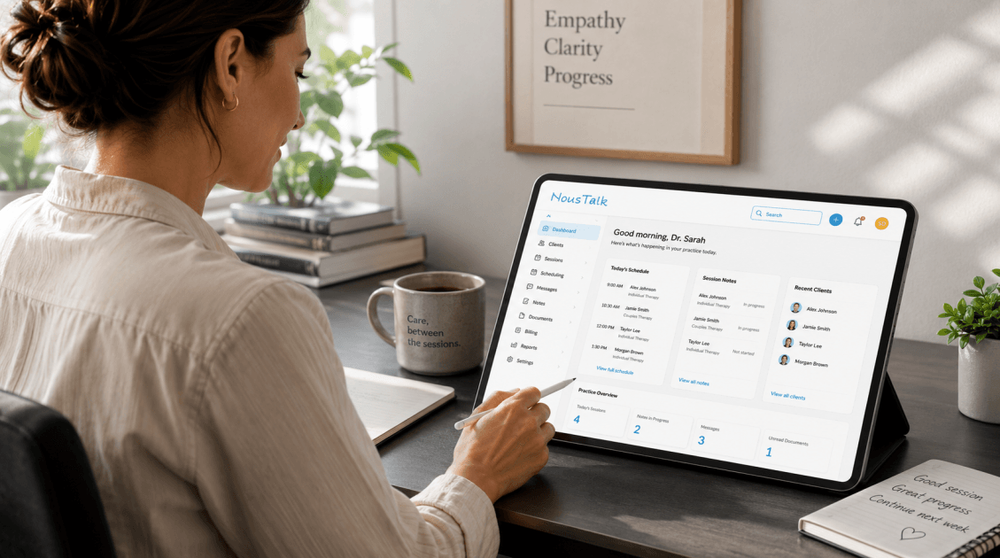
Optimizing Clinical Workflow with EHR Software
The average clinician spends more time on documentation than on direct client care. That ratio has shifted over the last decade, and not in the right direction. A well-configured EHR should push it back.
What "optimized" actually means in practice
Optimization isn't speed for its own sake. It's removing friction from the parts of the workflow that don't require clinical judgment — scheduling, intake, note templates, billing — so the clinician's attention can stay where it belongs.
A useful EHR does less, not more. It handles the administrative cycle cleanly so the clinician doesn't have to hold it in their head alongside the clinical work.
The clinical cycle, end to end
A mental health practice runs on a repeating cycle: intake, session, documentation, billing, follow-up. Each step generates information the next step depends on.
Intake — digital intake forms completed before the first session mean the clinician arrives at the appointment with context, not a clipboard. Consent, demographics, presenting concerns, insurance details — collected once, accessible throughout.
Session — the session itself should be uninterrupted. Notes written during or immediately after, using structured templates calibrated to the practice's modalities.
Documentation — progress notes, treatment plans, risk assessments. Version-controlled, timestamped, and attached to the right client record without manual filing.
Billing — session data should flow directly into billing without re-entry. Superbills generated automatically, payment tracked, outstanding balances visible at a glance.
Follow-up — automated reminders reduce no-shows. Secure messaging keeps communication in the record, not in a personal inbox.
Choosing the right EHR for a mental health practice
General-purpose EHRs are built for volume medicine — high client throughput, diagnostic codes, prescriptions. Mental health practice runs differently. The EHR should reflect that.
Look for:
- Session-based scheduling, not appointment slots sized for a GP visit
- Progress note templates designed for therapy modalities, not SOAP notes adapted from primary care
- Client portal access that supports the therapeutic relationship rather than just appointment reminders
- Multi-provider support for practices with associate clinicians, supervised trainees, or multiple locations
- Compliance coverage for HIPAA, PHIPA, and Loi 25 — built in, not bolted on
The documentation burden is a clinical risk
When documentation takes too long, it gets delayed. Delayed notes become incomplete notes. Incomplete notes are a liability — clinically and legally. An EHR that makes documentation faster and more structured isn't a productivity tool. It's a risk management tool.
The work is the session. The EHR should make everything around it easier.
Integrated EHR & Clinical Notes
Connect notes, treatment plans, and assessments in one unified portal.
Explore Feature Page