ADHD in the Classroom: A Teacher Checklist to Strengthen Your Assessment
Listen to this post
Listen to this post
A clinical overview of ADHD in school settings, how to gather collateral from teachers, and a free downloadable checklist to bring structure to what they observe.
Key takeaways
• ADHD is one of the most common neurodevelopmental disorders in children, and the DSM-5-TR requires symptoms in more than one setting — which makes the classroom a key source of information.
• Teachers often spot the behaviour first, but rarely have a framework for recording it usefully. A structured checklist closes that gap.
• Collateral from a teacher complements — it never replaces — a full clinical evaluation across multiple informants and settings.
• We’ve included a free, print-ready ADHD Classroom Observation Checklist you can send to a teacher and save to the client’s record.
A parent sits across from you, worried. Their eight-year-old “can’t focus,” the report card says “not living up to potential,” and the teacher has mentioned ADHD. You know that to assess this well you need to see how the child functions outside your office — especially at school, where sustained attention and sitting still are demanded for hours. So you ask the teacher to weigh in. What comes back is a warm, handwritten note: “He’s a sweet kid but very distracted and out of his seat a lot.” True, probably. Useful for a diagnostic picture? Not quite.
That’s the gap this article is about. Teachers are often the first to notice ADHD-type behaviour, but noticing isn’t the same as documenting it in a form that supports assessment. Here’s a clinical overview of how ADHD shows up at school, how to manage the collateral you collect from teachers, and a free checklist designed to turn “he’s very distracted” into structured, ratable observations you can actually use.
What is ADHD?
Attention-deficit/hyperactivity disorder (ADHD) is a neurodevelopmental disorder marked by a persistent pattern of inattention and/or hyperactivity-impulsivity that interferes with functioning or development. It’s among the most commonly diagnosed neurodevelopmental conditions in childhood.
The DSM-5-TR organizes the symptoms into two domains, each with nine criteria. The inattention domain covers behaviours like overlooking details, difficulty sustaining attention, not seeming to listen, losing things, and being easily distracted. The hyperactivity-impulsivity domain covers fidgeting, leaving one’s seat, difficulty waiting, blurting out answers, and interrupting. For children up to age 16, a diagnosis generally requires at least six symptoms in a domain; for those 17 and older, five.
Beyond the symptom count, several conditions matter for the picture as a whole. Several symptoms need to have been present before age 12. They have to show up in two or more settings — for example, at home and at school. They must persist for at least six months, and there must be clear evidence they interfere with social, academic, or occupational functioning. Based on which domains predominate, clinicians describe ADHD as predominantly inattentive, predominantly hyperactive-impulsive, or combined presentation.
That “two or more settings” requirement is exactly why teacher input carries so much weight. A child who seems fine in a quiet one-to-one office can look very different in a busy classroom — and the school setting is often where attention and activity demands make symptoms most visible and most impairing.
ADHD checklist for teachers and therapists
A good teacher checklist does one thing well: it translates classroom behaviour into the same language your assessment uses. Instead of a general impression, you get specific behaviours, each rated for how often they occur relative to same-age peers.
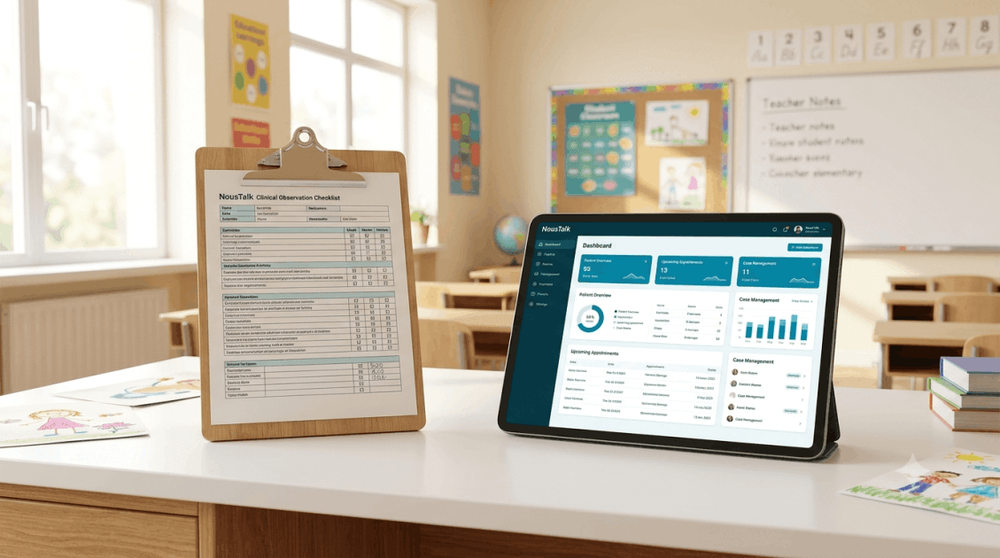
The downloadable checklist included with this post is built around the DSM-5-TR symptom domains, so it maps cleanly onto the framework you’re already working in. It has a section for inattention and a section for hyperactivity-impulsivity, each with nine plainly worded, classroom-anchored items rated on a simple frequency scale (never, occasionally, often, very often). It also asks about classroom performance, whether the behaviours appear across time and settings, and leaves room for specific examples.
A few important caveats, because precision matters here. This checklist is a collateral observation tool, not a diagnostic test. No score on it confirms or rules out ADHD; it gathers structured information to inform your clinical judgment. It’s also not the only option: validated, well-studied teacher instruments exist, most notably the NICHQ Vanderbilt Assessment Scale (teacher informant), which is freely available and widely used. Many clinicians use a validated scale as the backbone of their assessment and a simpler observation checklist as a quick, readable complement. Use whatever fits your process — the goal is structured data from the classroom, however you gather it.
Classroom management techniques
Teachers will often ask what they can do while an assessment is underway, and it helps to be able to point them toward strategies that have evidence behind them. These aren’t treatment, and they’re not yours to deliver — but knowing them lets you have a more useful conversation with the school, and they can support a child regardless of where the assessment lands.
The best-supported classroom approach is behavioural classroom management — a teacher-led system that reinforces positive behaviour rather than only reacting to problems. Common, evidence-informed elements include:
• Clear, consistent expectations. Posting a small number of concrete rules and reviewing them routinely gives a child a predictable structure to work within.
• Immediate, specific positive feedback. Catching and naming the behaviour you want (“nice job starting right away”) tends to work better than waiting to correct what you don’t.
• A daily report card. A simple home-school note tracking a few target behaviours, shared with parents each day, is one of the more studied tools for improving classroom behaviour and engagement.
• Shorter task segments and movement breaks. Breaking work into chunks with brief activity changes helps sustain effort.
• Organizational supports. Teaching planning, time management, and ways to keep materials organized reduces the friction that trips many of these students up.
• Reducing distractions and using multi-modal teaching. Preferential seating, visual aids, and hands-on activities can all help attention.
It’s worth noting that even though these strategies are well established, only about a third of children with ADHD receive behavioural classroom management — so a gentle nudge toward the school’s support team is often genuinely helpful.
ADHD paperwork for teachers
Collateral is only as useful as it is manageable, and the paperwork can pile up fast: a rating scale, an observation checklist, a release of information, maybe a follow-up form later in treatment. A few habits keep it from becoming a burden — for you or the teacher:
• Get consent first. Before contacting a school, make sure you have the parent’s (and where appropriate, the child’s) signed authorization to exchange information. This is foundational, and the specifics depend on your jurisdiction and setting.
• Send less, but send it clearly. A teacher juggling 25 students is more likely to complete one well-designed form than three overlapping ones. Pick the instrument you’ll actually use and include brief instructions.
• Make the ask specific and time-bounded. “Please rate these behaviours over the past six months and return by Friday” is easier to act on than an open-ended request.
• Keep it organized in the record. Date each form, note who completed it, and store it with the rest of the client’s file so the classroom picture sits alongside everything else you’re integrating.
• Close the loop. A short thank-you and, where consent allows, a note on next steps keeps the school engaged if you need them again.
The aim is a clean paper trail that supports your documentation without consuming your week — or the teacher’s.
How to use the ADHD checklist for teachers
Here’s a simple way to put the checklist to work:
1. Secure consent and identify the right teacher. Choose the educator who sees the child most across varied tasks — often the homeroom or primary classroom teacher.
2. Send it with context. Explain briefly what you’re asking and why, attach the checklist, and give a clear return date. A short note that it should reflect the past six months helps.
3. Ask them to rate against same-age peers. The comparison to typical development is what makes the ratings meaningful, so make that framing explicit.
4. Read it alongside your other data. Look for behaviours rated “often” or “very often,” consistency across the two domains, and whether the classroom picture lines up with what parents and you are seeing. The form informs — it doesn’t decide.
5. Save it to the record and integrate it. File the completed checklist with the client’s documentation and fold your observations into your assessment notes.
6. Reuse it to track change. If treatment or school supports begin, a repeat checklist later can offer an informal read on whether classroom functioning is shifting.
The checklist also includes a short scoring guide, which works like this: count a symptom as “present” when it’s rated often or very often, then tally each domain separately. Mirroring the DSM-5-TR symptom thresholds, six or more present items in a domain (five for ages 17 and up) is worth close attention — but treat that as a guide for your review, not a validated cut-off or a diagnosis. The performance and context sections matter just as much as the counts: difficulties should appear across settings, last at least six months, and interfere with functioning. As ever, the form is one input you integrate with parent report and your clinical judgment; no score on it confirms or rules out ADHD.
The completed form is built to be uploaded directly into your electronic health record (EHR), so the classroom data lives in the same place as the rest of your assessment.
Where your tools can help
The friction in collateral work is rarely the clinical thinking — it’s the logistics of getting a form out, getting it back, and keeping it with everything else. When you can store a completed teacher checklist alongside the client’s chart, reference it in your assessment notes, and find it again at the next review, the classroom picture stays connected to the rest of the file. In NousTalk, you can save documents like this to a client’s record and document your observations in the same place as your notes, so collateral doesn’t end up scattered across your inbox and a filing cabinet.
The bottom line
Teachers see something you can’t: how a child functions in the setting where attention and self-regulation are tested all day. The challenge is capturing that view in a form your assessment can use. A structured, DSM-aligned checklist does exactly that — turning a kind but vague note into ratable observations, while keeping the diagnosis where it belongs, with you and the full clinical picture.
Download the checklist below, send it to a teacher on your next ADHD assessment, and see how much sharper the classroom data comes back.
Download the checklist
•
(Print-ready PDF. It’s a collateral observation tool, not a diagnostic instrument.)
Further reading / Sources
• DSM-5 Diagnostic Criteria for ADHD — American Psychiatric Association (PDF)
• Clinical Practice Tools — CHADD (Children and Adults with Attention-Deficit/Hyperactivity Disorder)
• Diagnostic Criteria in ADHD — Changes in DSM-5 — Indian Journal of Psychiatry / PMC
This article is for general educational purposes and isn’t clinical, legal, or diagnostic advice. ADHD assessment should be conducted by a qualified clinician using information from multiple informants and settings. Follow your scope of practice and your college, board, or association’s standards, and handle school collateral and consent in line with the privacy rules that apply where you practise.
Digital Intake Forms & Assessments
Send standardized questionnaires and clinical checklists automatically.
Explore Feature Page