A Practical Guide to ACT Therapy Worksheets
Listen to this post
Listen to this post
The Hexaflex, the Skills, and Why the Paper Helps
A working tour of acceptance and commitment therapy worksheets — what the model is, the six processes behind it, the kinds of skills they teach, and where between-session sheets earn their keep.
Key takeaways
• ACT (acceptance and commitment therapy) is an evidence-based approach that helps clients build psychological flexibility — the ability to stay open to hard inner experiences while still acting on what matters to them.
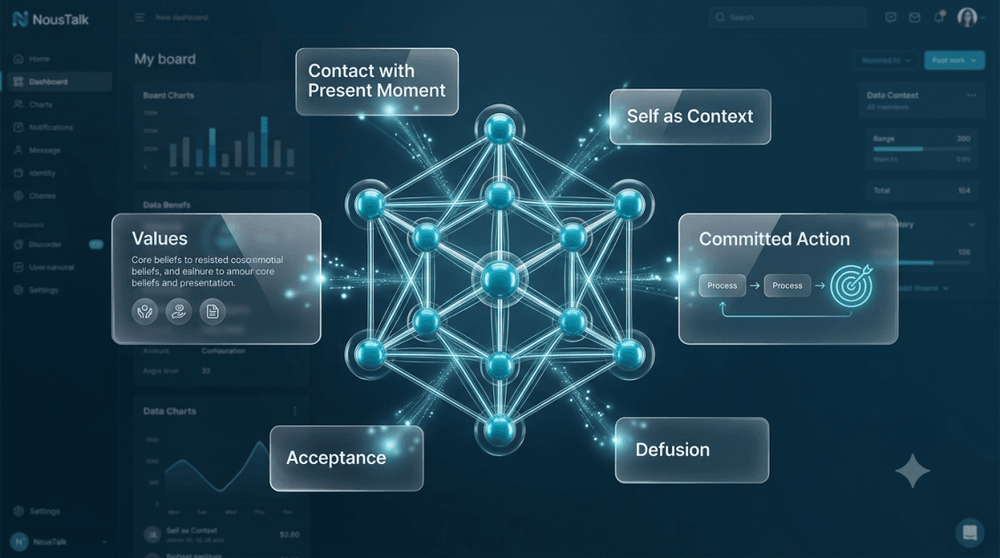
• The hexaflex is ACT’s six-process map: acceptance, cognitive defusion, contact with the present moment, self-as-context, values, and committed action. Worksheets usually target one process at a time.
• ACT skills fall into recognizable families — defusion, acceptance, mindfulness, perspective-taking, values, and committed action — and most worksheets are simply a structured way to practise one of them.
• Worksheets don’t do the therapy. They extend it: a shared language, a between-session anchor, and a prompt for the reflection that happens back in the room with you.
You know the moment. A client can describe the thought that’s running their week in fine detail — I’m going to fail, everyone can tell, there’s no point trying — and they can tell you exactly how much they believe it. What’s harder is helping them hold that thought a little more loosely and still walk into the meeting, the date, the hard conversation. That gap, between what the mind says and what the person does, is the territory acceptance and commitment therapy works in.
If you’ve gone looking for ACT worksheets, you’ve probably found a flood of them — values cards, “leaves on a stream,” willingness scales — without much sense of how they fit together. This guide is the map. It covers what ACT is, what the hexaflex actually describes, the main types of ACT skills, and where worksheets genuinely help (and where they don’t). The aim is that you finish able to pick a sheet on purpose rather than by vibe.
What is ACT therapy?
Acceptance and commitment therapy (usually said as the word “act,” not the letters) is a form of behavioural therapy developed by psychologist Steven C. Hayes and colleagues, grounded in a body of work called relational frame theory. Rather than trying to challenge or eliminate difficult thoughts and feelings, ACT helps people change their relationship to those experiences — making room for them while moving toward a life that reflects their values.
The central goal is psychological flexibility: the capacity to stay in contact with the present moment, open up to uncomfortable thoughts and emotions rather than fighting or avoiding them, and keep taking action in the service of what matters. Its mirror image, psychological inflexibility — getting tangled in thoughts, avoiding distress, losing sight of values — is what ACT treats as the common root of a lot of suffering.
On the evidence: ACT is recognized as an empirically supported treatment by the American Psychological Association’s Society of Clinical Psychology (Division 12), with research support across depression, mixed anxiety conditions, chronic pain, obsessive-compulsive disorder, and psychosis, among others. Reviews of the meta-analyses describe it as a credible, broadly transdiagnostic approach — generally better than no treatment or treatment-as-usual, and roughly comparable to other active treatments such as traditional CBT rather than dramatically better than them. In other words: solid, well-supported, and worth honest framing rather than hype.
What is the ACT hexaflex?
The hexaflex is the six-pointed diagram ACT clinicians use to map psychological flexibility. Each point is one of six core processes, and the model’s whole premise is that they overlap and support one another — you’re rarely working on just one. Together, all six are psychological flexibility.
It helps to picture the hexaflex in two halves. The processes on one side are the mindfulness and acceptance side; the ones on the other are the commitment and behaviour-change side. Here are the six:
1. Acceptance — making room for painful feelings, urges, and sensations instead of struggling to push them away. Not resignation; willingness.
2. Cognitive defusion — stepping back from thoughts and seeing them as words and pictures the mind produces, rather than literal truths or commands to obey.
3. Contact with the present moment — bringing flexible, intentional attention to here and now, rather than living in rumination about the past or worry about the future.
4. Self-as-context — noticing the “observing self,” the stable vantage point from which a person experiences their thoughts and feelings without being defined by them.
5. Values — clarifying what genuinely matters to this person: the qualities they want to stand for and move toward, distinct from goals they can tick off.
6. Committed action — taking concrete, values-guided steps, and getting back on course when life knocks them off it.
Used as a clinical tool, the hexaflex doubles as a case-formulation aid. When a client is stuck, you can ask which process is jammed — fused with a thought? avoiding a feeling? unclear on values? — and choose an intervention to match. Most ACT worksheets are built to exercise one of these six points, which is exactly why knowing the map makes the worksheets make sense.
Types of ACT skills
ACT skills tend to cluster around the hexaflex processes. You don’t need to teach them in order, and you’ll often blend them, but these are the families worth recognizing.
• Defusion skills create distance from sticky thoughts. The classic prompt is adding “I’m having the thought that…” in front of a difficult belief — “I’m having the thought that I’ll fail” lands differently than “I’ll fail.” Other defusion moves include silently thanking the mind for a worry, saying a harsh thought in a cartoon voice, or the well-known Leaves on a Stream exercise, where the client pictures each thought placed on a floating leaf and carried downstream.
• Acceptance and willingness skills help a client allow an emotion to be present without acting to escape it. Worksheets here might guide someone to locate a feeling in the body, describe it with curiosity, and rate their willingness to make room for it while still doing what matters.
• Present-moment and mindfulness skills train flexible attention — brief grounding practices, mindful breathing, or noticing-five-senses exercises that pull a client out of autopilot and back into now.
• Self-as-context skills help a person take the observer’s seat — exercises that separate “the you who notices” from “the thoughts being noticed,” so a passing feeling stops feeling like a permanent identity.
• Values skills are about clarifying direction. Tools like values card-sorts, life-domain “bull’s-eye” sheets, or prompts about what a person wants to stand for help separate genuine values from borrowed shoulds — and, importantly, from goals.
• Committed-action skills turn values into movement: small, specific, values-linked steps, willingness ratings for the discomfort that comes with them, and plans for getting back on track after a setback.
A quick clinical note worth keeping in mind: values and goals get blurred constantly. A value is a direction (“be a present parent”); a goal is a milestone you can complete (“attend the recital”). Good values worksheets keep that distinction intact, because collapsing the two is one of the more common ways ACT homework quietly goes off the rails.
Benefits of ACT therapy worksheets
Worksheets aren’t the therapy — the work happens between you and the client. But used well, they earn their place:
• They make abstract ideas concrete. “Defuse from your thoughts” is hard to act on; a half-page sheet that walks a client through it is not. Worksheets translate ACT’s somewhat abstract processes into something a person can actually do.
• They extend the hour. ACT is a skills approach, and skills need reps. A worksheet gives the client a structured way to practise between sessions, when most of real life actually happens.
• They give you a shared language. Once a client has done a values bull’s-eye or a willingness sheet, you can both point back to it — “remember where that landed on the page?” — which makes the next conversation faster and more grounded.
• They support your documentation. A completed sheet is a concrete artifact of what you assigned and what came back, which can feed naturally into your progress notes and your sense of how the work is moving.
• They lower the activation energy. A blank page is intimidating; a guided prompt isn’t. For clients who freeze on “just notice your thoughts this week,” a sheet gives them a place to start.
The honest caveat: a worksheet is a prompt, not a cure, and the gold is usually in the debrief, not the page. What the client noticed, resisted, or felt while doing it is the material you explore together. A sheet handed out without that follow-up tends to vanish into a bag. And as with any tool, fit matters — a defusion exercise can feel dismissive to someone in acute distress, so your clinical judgment about timing and match stays in charge.
A simple way to choose a worksheet
When you’re not sure which sheet to reach for, work backward from the hexaflex:
7. Name where the client is stuck. Tangled in a thought? Avoiding a feeling? Unclear on what they want? On autopilot?
8. Map it to a process. Fusion → defusion. Avoidance → acceptance/willingness. Lost direction → values. Trouble following through → committed action.
9. Pick one skill, not five. A single, well-matched exercise beats a packet the client won’t finish.
10. Plan the debrief. Decide before you assign it what you’ll be curious about next session.
Where your tools can help
Between-session work only helps if it actually makes it into the week — and back into the room. Being able to send a worksheet to a client through a secure portal, keep the completed version with their record, and pick the reflection back up at the next session keeps these exercises from disappearing. In NousTalk, you can share resources like these alongside a client’s chart and document the follow-up with your session notes, so the skill you assigned and the conversation it sparks stay connected.
The bottom line
ACT worksheets are most useful when you treat them as what they are: structured practice for one of the six processes on the hexaflex, chosen on purpose and followed by a real conversation. Knowing the map — what ACT is after, what each process does, and which skills serve which point — turns a pile of sheets into a deliberate toolkit.
If you’re curious, pick one process you find yourself returning to with clients, choose a single worksheet that targets it, and try it as this week’s between-session practice. Then notice what the debrief opens up. That reflection, not the paper, is where the work lives.
Download the worksheets
Four ready-to-print client sheets, each targeting one part of the hexaflex:
•
•
•
•
(Print-ready PDFs, designed to hand or send directly to clients. A combined packet with a cover page is included too.)
Further reading / Sources
• Steven C. Hayes — developer of ACT and relational frame theory
• The Six Core Processes of ACT — Association for Contextual Behavioral Science (ACBS)
This article is for general educational purposes and isn’t a substitute for clinical training, supervision, or your own clinical judgment. ACT is a model best learned through training and practice; match any intervention to the individual client, your scope of practice, and your college, board, or association’s standards.
Custom Form Builder
Create custom intake assessments, consent forms, and therapy worksheets.
Explore Feature Page